


Tibetan medicine today
In Buryatia as in the West Tibetan medicine had to match with the dogmas, visions and methods of natural science. In the 1960s the government decided that research on Tibetan medicine should be resumed. In 1968 a department for Eastern medicine was established at the Soviet Academy of Science in Ulan-Ude. Books were translated, recipes researched and ingredients analyzed. In addition, the assistance of the few still remaining knowledgable lamas who had survived was deliberately requested. Buryat Tibetan medicine found a home again – in the laboratories of the Soviet scientists.
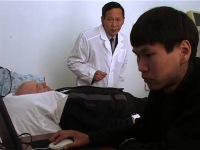 Computerized pulse diagnosis
An interesting example of how Soviet science has approached Tibetan medicine is the development of an automated pulse-reading machine. The project started in 1983, again with an interdisciplinary team consisting of engineers, tibetologists, computer experts, mathematicians and an old emchi, who came back from Manchuria, where he had fled to during the purges in the late 1930s. Together they started to look at pulse diagnosis with scientific rigor. Today, after 20 years of work, their machine is being field-tested in three public hospitals.
The diagnosis the machine delivers is a Tibetan one – it still needs a physician familiar with Tibetan medicine to make sense of it. As a next step an expert system is now being developed that should translate the results into a Western diagnosis .
The interesting question is how other Tibetan doctors see the project. Of course sometimes the scientists are smiled at. An emchi may think: “What is this good for? I only need my hands.” But the team has commanded respect over the years. And most emchis know that the nimbus of science is finally helping their cause.
The diagnosis the machine delivers is a Tibetan one – it still needs a physician familiar with Tibetan medicine to make sense of it. As a next step an expert system is now being developed that should translate the results into a Western diagnosis .
The interesting question is how other Tibetan doctors see the project. Of course sometimes the scientists are smiled at. An emchi may think: “What is this good for? I only need my hands.” But the team has commanded respect over the years. And most emchis know that the nimbus of science is finally helping their cause.
Eastern Medicine Center in Ulan-Ude
Towards the end of the 1980s Gorbachov ‘s Perestroika started. The conditions for Tibetan medicine changed again. It came to be seen as an important part of Buddhist Buryat identity. For a long time Tibetan medicine had been restricted to research and the research laboratories. Now it found its way into doctors` practices again and became part of the official health care system: in 1989 the officially recognized Eastern Medicine Center was established in Ulan-Ude.
Here, in the white lab coats of biomedicine a distinctive Buryat Tibetan medicine is practised and a broad spectrum of Eastern healing methods is used. A transformation of Tibetan medicine that sometimes meets with opposition in the Buddhist world.
Here, in the white lab coats of biomedicine a distinctive Buryat Tibetan medicine is practised and a broad spectrum of Eastern healing methods is used. A transformation of Tibetan medicine that sometimes meets with opposition in the Buddhist world.
Aginski Buryat Buddhist Institute
Following the disintegration of the Soviet Union, Tibetan medicine also found its way back into the monasteries. In 1993 the Aginski Buryat Buddhist Institute was founded. It also has a medical program. In 2003 the monastic university expanded and it now includes a Western style medical college as well, which leads to an officially recognized qualification as “medical doctor”. This is probably a unique thing: Tibetan and Western medicine taught together under one monastic roof.
Continue with: More background information
Continue with: More background information